Thursday, August 19, 2021

2019 Cabernet Sauvignon


The 2019 Cabernet Sauvignon is a classic example of full-bodied, big red wines produced from grapes grown on the Wahluke Slope.  Our 2019 vintage features coffee, black cherry and blackberry aromas followed by ripe, velvety fruit flavours, silky tannins and a warm, lingering finish.

The wine was crafted over thirty-two months.

Technical Stuff

  • 2019 was a typical season on the Wahluke Slope; however, September rains pushed the harvest out to October 15, a month later than expected

  • Pre-harvest testing revealed fruit to be roughly 26 degrees Brix (sugar content)

  • During harvest, the club grapes were packed in 600 pound cardboard totes and shipped to Fort Langley via refrigerated trucking

  • After a cold soak of 72 hours, yeast fermentation was initiated and concluded over 10 days

  • Malo-lactic fermentation was induced and progressed over a period three months, after which the wine was transferred to new and neutral oak barrels, where it remained for 27 months

  • Bottling took place on April 14, 2022

  • Due to ongoing supply chain issues, wax was used to seal the bottle tops instead of tin capsules

  • 15.7% alc./vol.

2019 Cabernet Syrah


The 2019 Cabernet Syrah is a blend of 2018 Syrah and 2019 Cabernet Sauvignon grapes grown on Washington State's Wahluke Slope.  It is a rich expression of the terroir featuring black cherry, bittersweet chocolate and blackberry aromas, followed by ripe velvety fruit flavours and a long, well-balanced finish.

The wine was crafted over thirty months.

Technical Stuff

  • 2019 was a typical warm and long season on the Wahluke Slope; however, September rains delayed the harvest by a month, pushing it to October 15th

  • Pre-harvest testing indicated that the fruit was approximately, 25.5 degrees Brix (sugar content)

  • During harvest, the club grapes were packed in several 600lb cardboard totes and cold shipped to Fort Langley

  • A cold soak of several days was employed after crush before initiating yeast fermentation

  • Malo-lactic fermentation was induced and progressed over a period of three months, after which the wine was transferred to new oak barrels, where it remained for 27 months

  • The wine was bottled unfiltered on December 10, 2022

  • Due to ongoing COVID restrictions at the US border, wax was used to sea the bottle tops instead of tin capsules.

  • 15.6% alc./vol TA 5.1g pH 3.96

Sunday, July 4, 2021

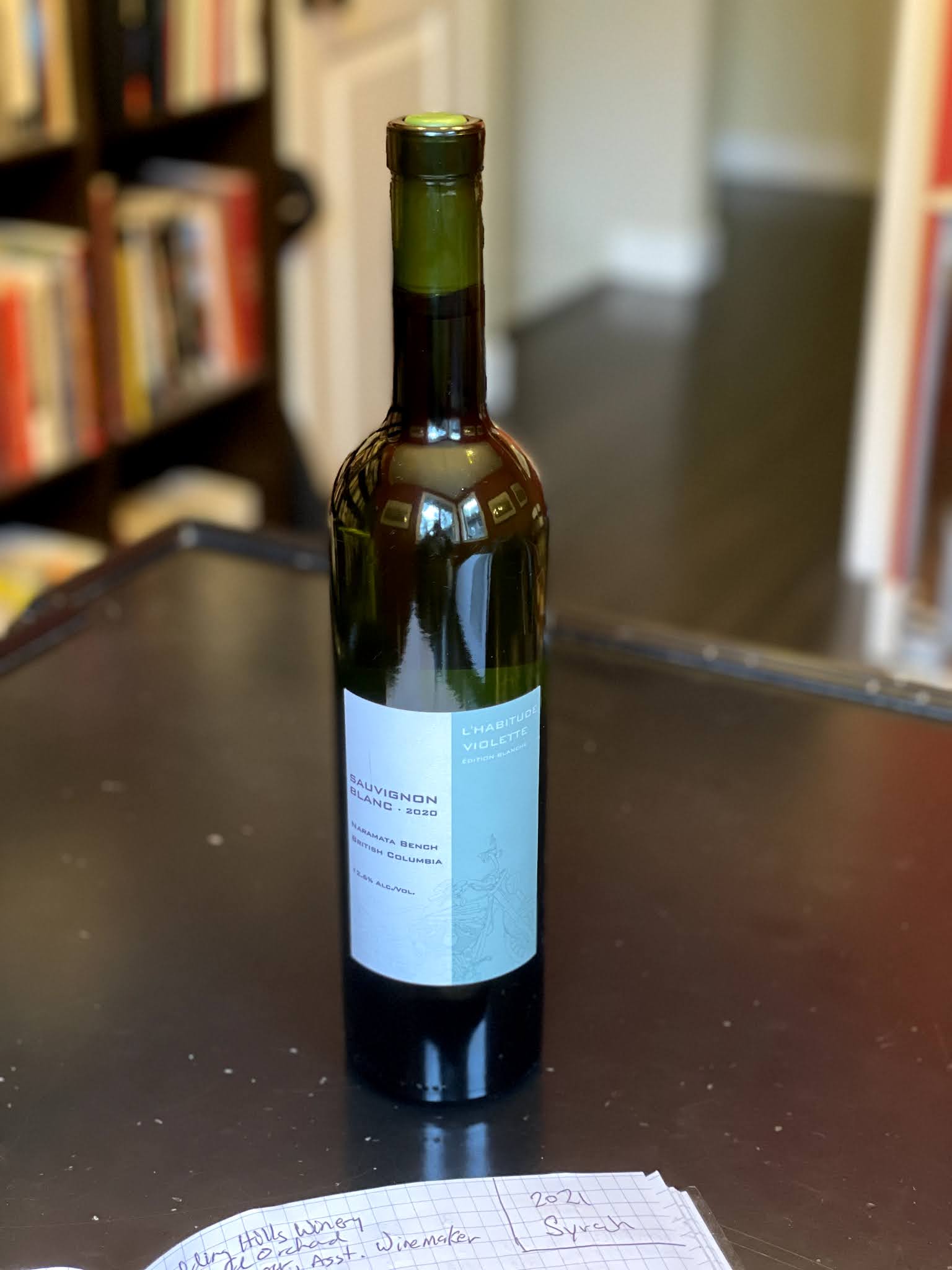
2020 Sauvignon Blanc


Okanagan Bound

The uncertainties of 2020 led us back to British Columbia for this year's harvest.  We are very grateful to Da Silva Vineyards for providing The Purple Habit with top quality Sauvignon Blanc fruit. 

The Journey

The 2020 Sauvignon Blanc was bottled on September 12, 2021 and is an expression of its New Zealand counterpart, featuring bright acidity with herbaceous, floral and tropical fruit.  Enjoy the juicy and citrus zing all alone or in the company of cheeses and seafood.


The wine was crafted over ten months.

Technical Stuff

  • 2020 was a slightly cooler than typical season on the Naramata Bench that pushed out harvest until October 9

  • Pre-harvest testing revealed fruit to be roughly 21.5 degrees Brix (sugar content)

  • During harvest, the club grapes were packed in 600 pound cardboard totes and trucked to Fort Langley by club members (it was sufficiently cold that reefer shipping was not required)

  • The fruit was pressed within 24 hours, separating the skins and pulp from the juice

  • Fermentation was conducted at 12 degrees Celsius over a period of three weeks

  • Fermentation and aging took place in stainless steel tanks; a light fining was applied and the wine was bottled unfiltered

  • Due to pandemic supply chain issues, the Sauvignon Blanc was bottled in dark green glass, in the style usually used for Bordeaux red wines.  Our standard tin capsules were also not available and wax was used to seal the bottle tops

  • 12.6% alc./vol.  TTA 7.5g   pH 3.13

Saturday, May 22, 2021

Spring 2021 Update

Spring

The English poet John Gay once wrote that "from wine does sudden friendship spring."  With May well upon us, and the start of another vintage anew, I reflected that in the fifteen years that we've been running the club there have been many friendships, some sudden, some enduring but all appreciated and valued.  

We had a few conniptions woven into our winemaking activities over the winter.  You may recall from the October update that our cellar air conditioner failed during the Sauvignon Blanc fermentation.  Thankfully, the weather turned about the same time, and a jury-rigged fan in the newly vacated air-conditioner opening managed to keep things cool during the fall and throughout the winter.  It is something of a bankrupting ordeal finding a shop that will work on small, custom air conditioners like ours, and I am now resolute in putting in a proper split HVAC system the next time we have chilling difficulties.

For the time being, we're pretty cool, tho...

And then, there was the barrel...


I may have mentioned in an earlier post that last year we had been having difficulties with a new barrel we had bought for the 2019 Cabernet Sauvignon.  Let's just say if it were a ship, everyone would have been bailing pretty hard to avoid our endeavour becoming a swim club.  We followed the vendor's advice and patched it full of sealing wax, waited, and even muttered a few words of prayer to any listening deity.  We continued to limp (leak) along until the first racking this winter, a process where we transfer wine between between the barrels to provide oxygen exposure and an opportunity to blend.  Racking relies on pressurized argon gas to push the wine out of the barrel.  Pressure and leak aren't words that any winemaker wants to hear in the same sentence, and the fluid outcome cost us a case or two of wine that I sadly mopped off the cellar floor.  Back to the vendor I went, strongly suggesting that they replace the barrel, which happened belatedly, although I had to cough up 1/4 of the cost.  ☹️

On a more positive note, the Cabernet is progressing well.  We will bottle later in the year, with a winter release on the horizon.  Our second attempt at racking (with new barrel) afforded a chance to enjoy a sample that was chock full of integrated flavours, including cherry, softening tannins, and oak vanilla.   


Sauvignon Blanc

We are very happy with our first Okanagan vintage in a decade, which is light, crisp and packed with melon flavours reminiscent of its New Zealand namesake.  I admit, Anita and I have "sampled" a few glasses over the past month (quality assurance, you understand), and I think you will agree that this vintage is the ultimate summer sipper.  We will be bottling in late June and should have it available in time for Canada Day.

Below, the story picks up again after last fall's fermentation and describes some of the key processes applied in the production of Sauvignon Blanc.

First racking took place a day after fermentation ended.  Lees (dead yeast) can be seen on the sides of the fermenting tank along with precipitated crystals of tartaric acid.  The hum in the background is the diaphragm pump that is used to gently transfer wine from one tank to another.  The wine cellar and large parts of the basement were imbued with the aroma of Sauvignon Blanc - it was lovely!


Another look at the fermenter tank after the wine was pumped off showing about 5cm of lees deposited on the bottom.  My father-in-law would have taken this fraction, put it in a carboy, and allowed it to separate further.  If I had that patience, we'd have gained another litre or so of wine.

Receiving tank point of view as fresh wine arrives from the fermentor.  Our rhythm for white wine making means that first racking occurs in the fall when temperatures are starting to subside.  In order to take advantage of the cold (how uniquely Canadian, eh?) the tanks are placed in our patio well, outside.  Over the next couple of months, when the mercury often dips below zero, the chilling effect causes tartaric acid in the wine to precipitate and cling to the walls of the tank.  This cold stabilization is an important step as it lowers the overall acidity of the wine, which in the case of Sauvignon Blanc can be quite high, and also prevents the crystals from forming in the bottle later on.  These harmless wine gems are sometimes mistaken by consumers as glass 😧

Second racking in late December clearly showed large amounts of tartrate crystals that were deposited during the two months spent outside.  At this stage, the Sauvignon Blanc which had also clarified significantly was pumped back into the cellar for the balance of the winter.  


By third racking in April, the wine began to sparkle with clarity, was almost ready to be bottled, and tasted like a finished product to be enjoyed along with the lengthening days and warming temperatures.  As a product of nature, wine contains a lot of different proteins produced by the grapes and yeast.  Some of these proteins (those thought to be from the grapes) are not stable in white wine and can produce haze or turbidity if the wine is warmed.   In order to remove those proteins, most winemakers use a compound called bentonite.


Bentonite, a type of clay mined in Wyoming, creates a negatively charged colloid when dissolved into water and mixed into wine.  Because wine proteins generally carry a positive charge, they are attracted to the bentonite, grow heavy, and gradually settle to the bottom of the tank.  This process, known as fining (pronounced "fine-ing"), is essential in making white wines heat stable and preventing haze and turbidity.


Preparing bentonite for the Sauvignon Blanc involved some of Anita's measuring bowls, bentonite granules, cold water, mixing, patience and a small mess.  Because the chemistry of our wine already lends itself well to stability (mostly its very low pH), I used only a small dose equating to about 1/5th of a gram for every litre of wine.  Higher doses can lead to over fining the wine and stripping away important flavours and scents.  The above slurry was mixed into the wine during a racking procedure several days ago.  After about a month, it will have all settled, and we will be ready to bottle.


A view of the cellar with working air conditioning, barrels that don't leak, and bentonite fined Sauvignon Blanc resting in the corner tanks.  

All is well!


Monday, October 19, 2020

2020 Sauvignon Blanc Harvest

Sauvignon Blanc 

The challenges surrounding COVID this year convinced us to pass on Washington State and return to the Okanagan for wine grapes.  It had been a decade since our last foray, and with some help from Anita's cousin in Penticton, we found a winery in Naramata that was willing to sell us Sauvignon Blanc.  Anita's family has deep roots in the Okanagan grape industry, and her dad's knowledge of the valley, its vineyards and agriculture is never lost on me when I visit.  

A wet spring initially set back growing in the valley, but a warm and dry summer made up for lost time, and we initially expected an earlier harvest towards the end of September.  Then, the smoke from California arrived, blotted out much of the growing energy delivered by the sun, and set the harvest back into October.  After a couple of false starts, we finally settled on Friday, October 9th, for harvest.

The pictures and video clips below tell the story of harvest, crushing, pressing and initial fermentation of this year's vintage.

Robert, hard at work cleaning the crusher de-stemmer before heading out to Naramata to pick up the crop.  This guy is amazing and comes from Quebec for harvest, every year.  In his off time, he even insulated my garage!

A big shout out to "Wayne & Freda", a trendy little cafe in Penticton with amazing sandwiches, baked goods, and coffee.

Vineyard manager Sophie bringing in one of two boxes of Sauvignon Blanc from the vineyard.  She picked in the rain and was thoroughly drenched by the time our shipment was ready.  #goodpeople

Almost 600lbs of fruit on the weigh scale.

Wrapping the boxes in poly to keep everything dry on the way home.

Richard, the owner and winemaker, showing his skill on the forklift.

One box loaded, one to go.  Robert was very careful to measure the boxes and ensure our rental truck had enough room.

Nearly 1300lbs of Sauvignon Blanc secured for the journey up the Coquihalla Pass and on to Fort Langley.  Our truck felt like a boat with the bow riding high on the water.

Five hours later in my garage with Robert and Brent - our crushing crew.

Getting set to start crushing.  No feet involved!

Crush begins!

Looking into the crusher de-stemmer.  The auger (visible) pulls the clusters of grapes over rotating rubber rollers.  The rollers can be set to gently crack the berries, fully crush them, or anything in between, depending on winemaking style.  Below the rollers (unseen) rotating paddles and a mesh separate the stems from the fruit.  For Sauvignon Blanc, we are fully crushing the berries.

Juice and crushed berries, now referred to as must, fall down the shoot into stainless steel buckets.  From there the must is loaded into stainless steel tanks and readied for pressing.


On to box number two.  Crushing itself took only about an hour; however, the preparation and cleanup required several hours of effort.

Sauvignon Blanc must in the tanks and ready for pressing the following day.

The conclusion of a big day that started with harvest 500KM's distant and completed with a thorough cleaning of all equipment and our garage.

Press begins!  With white wine grapes, it is typical to press immediately after crushing.  Unlike red wine grapes, whites ferment on juice instead of must.

Our press crew had some fresh help...

and club members who took part in the earlier crush.

For this year's vintage, we are using a specialised yeast to highlight flavours typically found in the New Zealand expression of Sauvignon Blanc.  Called Alchemy for its magical powers πŸ˜‰it produces thiols, or sulphur compounds that give Sauvignon Blanc its characteristic grassy, boxwood, passion fruit and citrus flavours.

The grape juice ferments in stainless steel tanks.  Without the lid, the foaming must is clearly visible.


To ensure that no oxygen contacts the wine, all tanks are sealed with lids.  Because the fermentation (especially in the beginning) is evolving significant quantities of carbon dioxide gas, a bubble lock is fitted to the lid.  The lock contains a water trap that allows CO2 out but no air in.

Music to the winemaker's ears!  With fermentation under way, the bubble locks are busy.  CO2 accumulation in the cellar is a significant safety concern, as it is possible to asphyxiate when concentrations are high.  Two professional wine makers in the Okanagan died in a related tragedy around the time we started making wine. 

As Robbie Burns said, the best made plans of mice and men go oft awry.  Such was the case when our cellar air conditioning unit failed.  It's important to ferment whites like Sauvignon Blanc in a cool environment.  Fortunately for us, mother nature helped out with cool and low October temperatures.

After taking the air conditioner in for servicing, a grill was placed over the opening of the cellar.  With a fan and some ducting installed inside, we've managed to keep things cool.

Ferment has been underway for six days, now.  In another week or so, all of the sugar provided by the grapes will have been consumed by the yeast leaving the wine still and dry.  Until then, warm regards from your friends at The Purple Habit.


Wednesday, July 22, 2020

2020 Summer Update and New Vintage Plans

We had a busy spring!

In amidst our rebranding to The Purple Habit, hiring a designer for our new lables, finding a local printing firm, chasing down a new supplier for bottles, and managing numerous personal and professional COVID-19 challenges, we managed to bottle -- what I think you will agree -- is an outstanding expression of the Syrah varietal.  Presenting . . . . our 2018 vintage!


Rebranding Complete!  A QR code now takes interested club members to a more detailed write-up on the vintage.

Bottling Day

On May 9th, we bottled the 2018 vintage.  In spite of all the equipment and people moving around, the process is well-practiced, and we moved through several tanks of wine over the balance of the day.  Had it not been for COVID-19, and a lack of volunteers (I like to think our kids volunteered 😏), we would have had club members on each of the stations pictured below.

Ready to go - tanks, pumps, bottles and other equipment, prior to starting.


The bottle filler accommodates 4 bottles at once and automatically fills each to a predetermined level.


Our two kids, Ben and Grace manning the bottle corker.  The corker works on a two step principal.  The operator pulls the lever down to compress the cork so that it can fit inside the neck of the bottle.  A final short push of the lever quickly inserts the compressed cork into the bottle where it expands and seals.  After processing several hundred bottles, anyone over 40 is pretty much guaranteed some shoulder agony.  These two didn't notice a thing.  Corking is wasted on the youth!

Corked bottles awaiting application of tin capsules for the neck of the bottles.  In a world full of plastic, we still invest in tin for our vintages.

Anita operating the capsule spinner, a device that literally molds the tin capsule to the top of the bottle.  Another shoulder killer!

We've been making wine together for almost 20 years πŸ’œ

Once the bottles are filled, corked, and capsuled, the new lables are applied.

The Purple Habit 2018 Syrah ready for boxing.

After clean-up, all equipment is stored in the garage until dry and ready for stowing.  Who recognises the new stylistic element included on our lables?


Vintage Plans for 2020

We had waited hopefully for some positive change in the COVID situation and the border, but I think it is for naught.  On a typical year, it's a enough of a challenge buying fruit in the States.  Unfortunately, we won't be going south for 2021.

However, I think there is a reasonable chance of finding quality Pinot Gris or Sauvignon Blanc locally in the Okanagan.  We've had good experiences with both varietals in the past, and each was well received by the club.  When I find a supplier, I will finalise the pricing.  Because white wines generally aren't processed or aged in oak barrels, the cost will be lower than our reds, most like around $325 a share (18 bottles).

Please let me know if you are interested.  We likely won't make as much as past red vintages.

We hope you are enjoying your summer!

Warm regards,

Darin, Anita, Grace and Benjamin

Monday, February 17, 2020

2019 Winter Update

Hello friends,

I was thinking of ways to modernize our updates when I remembered starting a wine-themed blog, back around the time my kids were born, circa 2008.  To my surprise, the blog was still there, having languished since my last post, way back a decade earlier.   I've moved some of our earlier wine updates over to the blog,  but this is the first one purpose written for our "new" communications channel.  For a guy who lives and breathes "digital transformation" in my day job, I'm a bit slow to the game personally.  Well, here goes...

We left off in October at the crush, and that was only half the fun for the new vintage.  The next step was to take a few measurements and then get down to the business of fermentation, that naturally occurring happenstance that to some happy extent begat and formed the civilization we know today.

Analytic Setup for Titratable Acidity
The rig above is used to determine the amount of acidity in the grape juice.  The amount of acid in the wine and its relative strength (pH) have a considerable effect on both taste and fermentation success.  Wines too low on acid taste flat and are also susceptible to microbial spoilage.  Wines with excess acid can be unbearably tart and not very enjoyable.  Because late harvest often equates to unripe fruit and high acidity, I was pretty keen to see where we had ended up.  Our acid target turned out to be right on the money, and there was no mistaking the excellent quality of our 2019 Cabernet Sauvignon.

With all the lab numbers looking great, we were ready to add yeast and get the fermentation underway.

Prepping the Yeast
It's a myth that fermentations can occur naturally and produce the relatively high alcohol wines that we enjoy today.  Ironically, the ethanol that yeast produce as a byproduct of sugar metabolism is toxic to them and generally kills the wild variety after it surpasses a level of five or six percent.  Nearly all wines today are fermented using cultured yeasts, some of which can withstand ethanol levels beyond fifteen percent.  If you ever hear a winemaker say "fermented with wild yeast" understand she's either making it up or relying on cultured yeast already in the vineyard from composting grapes skins of previous fermentations.

Fermenting in the Garage
Once the yeast is hydrated in warm water (just like baking bread), it gets added to the fermenters, and the show begins.  This year fermentation took eight days to complete.  Fermentation creates a lot of carbon dioxide, which can be dangerous to breath.  We always ensure the garage door is opened, before we check on the tanks.  It is a sad fact that occasionally wine makers are overcome by carbon dioxide and perish.  Unfortunately, this tragedy has happened in British Columbia, since we started making wine.

During the fermentation process, the grapes eventually break down into skins and free run juice, or wine.  Ultimately, when the mixture is poured into the wine press, the free run juice runs right through the press and into a receiving pail.

Darin and Joe loading the Wine Press from the Fermenter Tanks

A Purple Mess is Nearly Unavoidable

"Free Run" Juice (Wine) Passing Through the Press into the Receiving Pail
Eventually, the press becomes full of skins and the juice that they retain.  Oak panels and blocks are placed over the skins, and a ratchet, screw drive assembly is tightened down compressing the skins and separating the remaining juice.  This type of press, which dates back over a thousand years, can squeezes the skins hard enough that the remaining mass, called the pomace, is nearly dry and paper like.

Wine Skins Remaining Without Free Run Juice

The Ratchet Screw Drive Compressing the Skins

The "Pomace" to be Recycled into Compost

The new wine remains in garage tanks for a few days to clarify, a process where dead yeast and other solids settle out of the wine and form a mud on the bottom of the tanks.  The wine is then transferred by gravity from the garage to tanks in the basement exercise room.  During this period of the young wine's life, a secondary process called malolactic fermentation takes place, a process where bacteria convert the sharper (apple tart) malic acids in the wine to milder lactic (milk) acids.  This process is nearly inevitable in any wine, so we like it to occur during the winemaking, rather than creating a fizzy bottle of wine on your supper table.

Wine Travelling by Gravity from Garage to Basement

A Receiving Tank in the Basement

Brand new 2019 Cabernet Sauvignon

New Wine Resting in the Gym

After a month or two, with the window partially open to keep the wine around 18 degrees Celsius, everything is transferred into 225 litre French oak barrels in the cellar for long term aging.  Our cellar is temperature and humidity controlled.  A wine cellar that is too dry, promotes undue evaporation of the wine from the oak barrels, reducing the overall yield and "giving too much to the angels."  We lose about one litre of wine a month from each barrel at 65% relative humidity - this is typical.

This year, for the first time in 15 years, one of our new barrels leaked.  We follow a standard procedure for preparing barrels that includes filling them partially with hot water prior to use.  This one was okay till the wine was added, and then it was quite the mess.  Fortunately, it looked worse than it was, and we only lost a couple litres of wine.  In the interim, I plugged the leaky oak staves with barrel wax.  Over a few weeks, the staves swelled up with wine and solved the problem.  Still a bit unsightly!

Slightly worried that a new ($2000) barrel was leaking wine like a sieve!

What a mess on the underside

Leak arrested.  The dark patches are barrel wax

With the 2019 Cabernet Sauvignon squared away for the foreseeable future, we turned our attention to the 2018 Syrah, which was pumped out of the barrels to tanks in the garage.  We expect to bottle and release sometime in the spring.  In the meantime, we are working on a new label design to reflect our rebranding as The Purple Habit.  We hope to share that with you soon.

All the best from Darin, Anita, Grace and Benjamin.